Last
month we discussed how to get data from Microsoft Access into Outlook
objects, such as in the creation of new appointments, tasks, contacts and
emails.
This month we perform the reverse operation: get data out
of Outlook into Microsoft Access. One might argue that there is an easier way
to accomplish what I show below, by using Access linked tables to Outlook or
Exchange data, but keep these two things in mind:
1) The
point of this article is to explain Outlook Automation
2) There
are fields available through automation not exposed in linked tables.
The code download that was posted last month contains the demo
code for both articles. It is made available again in this
link.
The idea for the following solution came from a management
request that users be able to upload their emails into a Contacts database
where other sales reps could see the history of email correspondence with each
contact. Accomplishing this requires:
-
scanning the users email folder(s)
-
assessing whether an email should be processed
-
determining if it has already been processed
-
saving message details to a database
Caveat Emptor
Before we explain the solution, there are a couple of things
its important to mention. While this code could run automatically when a user
opens the application, it may or may not be ethical to secretly extract all of
their correspondence into a database to which others have access. In my
implementation I always left it up to the user to initiate the extraction and
gave them control over which folder(s) were processed.
Why? Well one might argue that any emails on an employees
work computer are fair game, but I can imagine a number of scenarios where a
user might have legitimate correspondence that should remain confidential. For
example, an employee who chooses to inform HR via email that they are HIV
positive might do so with the expectation of privacy.
An additional consideration has to do with performance. I
found that some of our users have tens of thousands of emails in their Inbox
and Sent folders. Processing them all requires no trivial amount of time. In
my implementations, I included a date filter so that processing would be
limited to a user-selected date. I also implemented a Cancel function so the
user could gracefully exit from the process if it was taking too long. You wont
find the code for the Cancel feature in the demo but its not difficult to
implement. If you want direction on that, post back to this article and Ill
write up the process.
One final point: The code in the article has been modified
to avoid line breaks where possible and will not exactly correspond to that
found in the demo code. I also noticed that some of my comment lines in the
demo code were nonsense. Since it had already been rolled out, I didnt try to
go back and correct it. Comments have a way of becoming obsolete.
Enumerate Outlook Mail Folders
The first step is to give the user an option for which mail
folders they wish to process. To keep the demo simple only the Inbox, Sent
Mail and their subfolders will be considered. Since subfolders of subfolders
are also enumerated, a function must be created that may be called recursively.
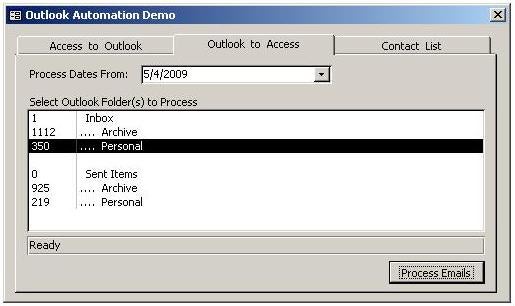
Below are the results from a scan of my Outlook folders
where my subfolders go only 1 level deep below the Inbox and Sent Items. Part
of the enumeration process is to get a count of the number of items in each
folder, which is displayed on the left. This listbox control has its
properties set to allow for multiple selections and the Process Emails function
will loop through the list and process only those folders and subfolders that
have been selected.
Hooking into an Outlook folder is relatively simple. You
basically need only two things: An instantiated Outlook object and a folder identifier.
For our top folders (Inbox and Sent Items) we need to pass the constants
supplied by Outlook to the GetDefaultFolder method. Since this example uses
late binding and no reference to the Outlook Library is set, I included
comments clarifying that Inbox is 6 and Sent Items is 5.
As with last months article, we use late binding here and
the CreateObject() method to set the object variable oOutApp to an instance of
Microsoft Outlook. Once we have the application object, we can instantiate a
top folder object for either the Inbox or Sent Items. This is all
accomplished in the function named GetMAPISubfolders() which accepts a long
integer value to identify which of our two top folders to process.
Public Function GetMAPISubfolders(ByVal lFldNum As Long) As String
On Error Resume Next
Dim oOutApp As Object ' Outlook.Application
Dim objTopFld As Object
' Received Mail ... Inbox lFldNum = 6
' Sent Mail ... Sent Items lFldNum = 5
Set oOutApp = CreateObject("Outlook.Application")
Set objTopFld = oOutApp.GetNamespace("Mapi").GetDefaultFolder(lFldNum)
' begin the recursive process with the top folder.
Call EnnumerateFolders(objTopFld, lFldNum)
Heres where the recursion comes in. The EnumerateFolders()
function, when it encounters a subfolder, calls the EnumerateFolders() function,
which in turn calls the EnumerateFolders() function on its subfolders and the
process continues in recursion until there are no more subfolders.
Each time it finds a folder, it writes the metadata to a table,
which ends up as the source of the listbox shown above in the demo form.
Private Sub EnnumerateFolders(ByRef oFld As Object, ByVal lFldNum As Long)
On Error Resume Next
Dim oFld As Object
Dim strIns As String
Dim strSQL As String
Dim arrFlds() As String
Dim intDep As Integer
Dim strFld As String
Dim intCnt As Integer
' We will load the folder list with an INSERT statement.
strIns = "INSERT INTO tblOutlookFolders " & _
"([FolderType],[FolderName],[ItemCount],[Depth]) "
' oFld.FolderPath = \\Mailbox - Lesandrini\Inbox \Archive
' By counting the slashes (allowing for the 2 in front) you
' can determine the folder depth
arrFlds = Split(oFld.FolderPath, "\")
intDep = UBound(arrFlds) - 2
strFld = Replace(oFld.Name, "'", "''")
intCnt = oFld.Items.Count
' Insert the folder info into tblOutlookFolders.
' The [Depth] column tells us how many folders downstream
' we are so we know how far to indent in the listbox.
strSQL = strIns & "VALUES (" & lFldNum & ",'" & _
strFld & "'," & intCnt & "," & intDep & ")"
CurrentDb.Execute strSQL
' process all the subfolders of this folder
For Each oFld In oFld.folders
Call EnnumerateFolders(oFld, lFldNum)
Next
Set oFld = Nothing
The code is pretty straight-forward but a few notes of
clarification. I perform a REPLACE() on the folder name to replace single
quotes with a pair of single quotes. This is to ensure that the INSERT statement
doesnt fail when processing a folder thats named something like OBrian, with
an embedded apostrophe. One could use a recordset object to add the record,
which is how its handled in the next example, but I like to switch it up to
keep things interesting.
The only other thing that might not be obvious is the intDep
variable. It represents the depth of the subfolder. The top folder is 1,
the first subfolder is 2, etc. Later this number will be used to add n groups
of dots (. . .) to give the subfolders the correct depth. A fancy
implementation could use the Treeview control, which is effectively what
Microsoft Outlook does, but I wanted to keep it as simple as possible and focused
on the Outlook automation model.
Youve Got Mail
Now that folders have been enumerated, we can process the
emails within a selected folder. The demo application includes the code for processing
selected rows of the list box and its basic stuff, so I wont reproduce that
here but the function it calls to process all emails for a named folder is
shown below.
Whats important to note here is that the variables lFolder
and sFolder are passed to this function. lFolder will either be 6 for Inbox or
5 for Sent Items and sFolder is the folders name/label. Given those two
pieces of information, you can instantiate a folder object and process it.
Note too that the Redemption model is implemented here.
Outlook security doesnt like it when its objects are accessed via automation
so if you want to avoid making the user click through security warning dialogs,
then follow the example below using a Redemption SafeItem. (See last months
article for a full explanation of the Redemption library.)
Public Function ProcessOutlookFolder(
ByVal lFolder As Long, sFolder As String,
Optional ByVal dFromDate As Date) As Boolean
On Error GoTo Err_Handler
Dim appOutlook As Object ' Outlook.Application
Dim objFolder As Object ' Outlook.MAPIFolder
Dim objSubFld As Object ' Outlook.MAPIFolder
Dim objInboxItems As Object ' Outlook.Items
Dim objOutMail As Object ' Outlook.MailItem
Dim objSafeItem As Object
Dim strEntryID As String
Dim intRecip As Integer
Dim strRecip As String
Dim strSubject As String
Dim strFrom As String
Dim dteSentDate As Date
Dim strBody As String
Dim intPriority As Integer
Dim strCC As String
Dim strSQL As String
Dim iCount As Integer
Dim strAddress As String
Dim strType As String
Dim dbs As DAO.Database
Dim rstNew As DAO.Recordset
Dim strLogin As String
Dim fExists As Boolean
Dim strMsg As String
' assume success
ProcessOutlookFolder = True
Set dbs = CurrentDb
If IsMissing(dFromDate) Then dFromDate = Date - 14
strLogin = "Demo User"
If lFolder = 6 Then strType = "Inbox" Else strType = "Sent"
Set oOutApp = CreateObject("Outlook.Application")
Set oFld = oOutApp.GetNamespace("Mapi").GetDefaultFolder(lFolder)
Set oSFld = GetEnummeratedFolder(oFld, sFolder)
Set oFldItems = oSFld.Items
Set oSafe = CreateObject("Redemption.SafeMailItem")
For Each oItem In oFldItems
oSafe.Item = oItem
With oSafe
strEntryID = .EntryID
dteSentDate = .SentOn
strSubject = .Subject
' Having collected the message EntryID, we can check
' the database to see if this message has already
' been processed. Based on that query, it is either
' added or skipped and the appropriate message shown.
strSQL = "SELECT * FROM tblEmailMsgs " & _
"WHERE [EntryID]='" & strEntryID & "'"
Set rstNew = dbs.OpenRecordset(strSQL, dbOpenDynaset)
fExists = Not (rstNew.BOF And rstNew.EOF)
iCount = iCount + 1
If fExists = True Then
strMsg = iCount & " ... already exists ... " & _
dteSentDate & " ... " & strSubject
Else
strMsg = iCount & " ... process new ... " & _
dteSentDate & " ... " & strSubject
End If
DoCmd.Echo True, strMsg
DoEvents
' Only process emails less than date specified.
If dteSentDate < dFromDate Then
Exit For
Else
If fExists = True Then
' don't process further
Else
strBody = .Body
intPriority = .Importance
strCC = .CC
strFrom = .SenderEmailAddress
strRecip = ""
For intRecip = 1 To .Recipients.Count
strAddress = .Recipients(intRecip).Address & ";"
strRecip = strRecip & strAddress & ";"
Next
With rstNew
.AddNew
!EntryID = strEntryID
!Priority = intPriority
!Subject = strSubject
!BodyText = strBody
!FolderName = Left(sFolder, 32)
!FolderType = strType
!ToAddress = Left(strRecip, 1024)
!FromAddress = Left(strFrom, 128)
!CCAddress = Left(strCC, 512)
!SentDate = dteSentDate
!CreatedDate = Now()
!CreatedBy = strLogin
.Update
End If
End With
End If
End If
End With
Next
This is the function you will need to modify to meet your
own personal needs. One feature we implemented was an email lookup to our
Customer Relationship Management database. If the email address wasnt found
to be in the database, the item was skipped. This saved us from importing
hundreds of spam and other emails that were not relative to our contacts
database.
If you dont have a CRM list of emails you may wish to limit
the import to persons who appear in your contact lists. To do this, we
implement another piece of the Outlook automation mechanism, hooking into the address
list object.
Enumerate Contact List
The code that follows was extracted from a newsgroup
post by Doug Haigh nearly a decade ago. Doug was having some issues with
the code but I got it working and the final result is in the download for this
article.
The function, DistListPeek(), peeks into all the distribution
lists and allows you to extract the names and email addresses. As you might
expect, the Outlook Security model doesnt like it when code does this either,
so again your users will get a security dialog asking for permission to
proceed. It seems like the Redemption library should allow a way to circumvent
this, but my initial attempts proved unsuccessful.
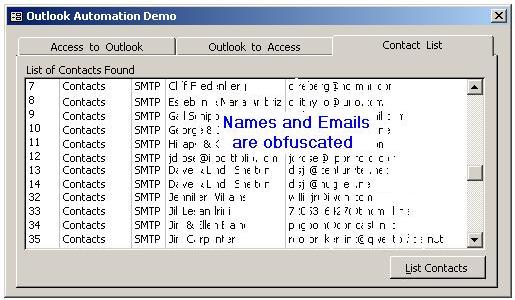
Again, I have a local table where the list items are saved
for display on the demo form. The code simply instantiates an Address List
object and interrogates it for lists and items, inserting each one into the
temp table as it goes. I found that some text parsing and cleanup had to be
done to get a good list and once again, this extent cleanup may depend on the
quality of your address lists.
Function DistListPeek()
On Error Resume Next
Dim oOut As Object ' Outlook.Application
Dim oNS As Object ' Outlook.NameSpace
Dim oAL As Object ' Outlook.AddressList
Dim oDL As Object ' Outlook.AddressEntry
Dim sSQL As String
Dim iPos As Integer
Dim sList As String
Dim sName As String
Dim sType As String
Dim sEmail As String
Set oOut = GetOutlookObject()
Set oNS = oOut.GetNamespace("MAPI")
oNS.Logon , , False, True
'Return the personal address book.
Set oNS = oOut.GetNamespace("MAPI")
sSQL = "DELETE FROM tblContacts"
CurrentDb.Execute sSQL
For Each oAL In oNS.AddressLists
iPos = 0
sList = oAL.Name
For Each oDL In oAL.AddressEntries
iPos = iPos + 1
sEmail = oDL.Address
sName = oDL.Name
sType = oDL.Type
' The Name property sometimes includes the Email address,
' so strip it out. Other times, it IS the email address.
sName = Trim(Replace(sName, "(" & sEmail & ")", ""))
If sName = "" Then sName = sEmail
sList = Replace(sList, "'", "''")
sType = Replace(sType, "'", "''")
sName = Replace(sName, "'", "''")
sSQL = "INSERT INTO tblContacts " & _
"(ListName, ListType, Position, Name, Email) " & _
"VALUES ('" & sList & "','" & _
sType & "'," & iPos & ",'" & _
sName& "','" & sEmail & "')"
CurrentDb.Execute sSQL
Next
Next
End Function
From here ...
The best way to understand this process is to run the code
in break mode, stepping through it one line at a time. This will allow you to
see how the text strings are parsed and to identify any issues that might arise
which are peculiar to your mail setup.
Personally, Im very excited about this demo code because it
brings together in one place all the snippets Ive used in various applications.
Its the kind of thing you could import into an application and start using
right away and because it relies on late binding, you neednt worry about the
version of Microsoft Outlook that the user has installed. The code supplied
with this article should be an adequate starting point for all your Outlook to
Access automation projects.
»
See All Articles by Columnist Danny J. Lesandrini