


As I’ve already explained, PHP is a server-side scripting
language that lets you insert into your Web pages instructions
that your Web server software (be it Apache, IIS, or whatever)
will execute before it sends those pages to browsers that request
them. In a brief example, I showed how it was possible to insert
the current date into a Web page every time it was requested.
Now that’s all well and good, but things really get interesting
when a database is added to the mix. A database server (in our
case, MySQL) is a program that can store large amounts of
information in an organized format that’s easily accessible
through scripting languages like PHP. For example, you could tell
PHP to look in the database for a list of jokes that you’d like
to appear on your Web site.
In this example, the jokes would be stored entirely in the
database. The advantage of this would be twofold. First, instead
of having to write an HTML file for each of your jokes, you could
write a single PHP file that was designed to fetch any joke out
of the database and display it. Second, to add a joke to your Web
site would be a simple matter of inserting the joke into the
database. The PHP code would take care of the rest, automatically
displaying the new joke along with the others when it fetched the
list from the database.
Let’s run with this example as we look at how data is stored in a
database. A database is composed of one or more tables,
each of which contains a list of things. For our joke
database, we’d probably start with a table called “jokes” which
would contain a list of jokes. Each table in a database has one
or more columns, or fields. Each column holds a
certain piece of information about each item in the table. In our
example, our “jokes” table might have columns for the text of the
jokes, and the dates on which the jokes were added to the
database. Each joke that we stored in this table would then be
said to be a row in the table. These rows and columns form
a table that looks like this:
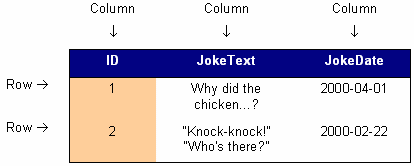
Notice that, in addition to columns for the joke text
(“JokeText”) and the date of the joke (“JokeDate”), I included a
column named “ID”. As a matter of good design, a database table
should always provide a way to uniquely identify each of its
rows. Since it’s possible that a single joke could be entered
more than once on the same date, the JokeText and JokeDate
columns can’t be relied upon to tell all the jokes apart. The
function of the ID column, therefore, is to assign a unique
number to each joke, so we have an easy way to refer to them, and
to keep track of which joke is which. Such database design issues
will be covered with greater depth in Chapter 5.
So, to review, the above is a three-column table with two rows
(or entries). Each row in the table contains a joke’s ID, its
text, and the date of the joke. With this basic terminology under
our belts, we’re ready to get started with MySQL.