


Active/Passive SQL Server 2000 clustering gives more
reliability and fault tolerance to Production SQL Server environments. When a
failure occurs, all of the resources fail over from the active node to the
passive node and make the passive node active. This article explains how to
rebuild the node that failed and attach it back to the cluster.
First, let’s assume we have the CLUSTER server
"VCLUSTER" with nodes "SQLNode1" and "SQLNode2."
Further, we will assume the virtual name of the SQL server is SQLCLUSTERA and
that VCLUSTER, SQLNode1, SQLNode2 and SQLCLUSTERA belong to the same domain
"VDOMAIN."
In this example, the node "SQLNode1" has failed due
to a major hardware failure, including local hard disks. Now all the failed
resources have failed over from SQLNode1 to SQLNode2. [Refer Fig 1.0]
Click for larger image
[Fig 1.0]
Step 1 – Evicting the failed node
Open the
Cluster Administrator and evict the node "SQLNode1" from the cluster "VCLUSTER."
[Fig 1.1 and 1.2]
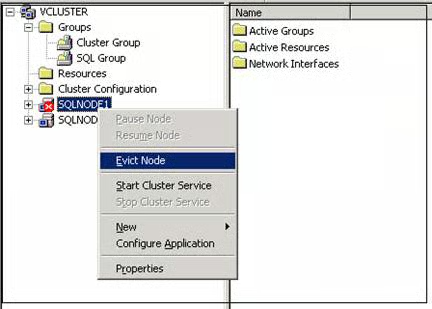
[Fig 1.1]

[Fig 1.2]
Step 2 – Install new hardware, network and update IP address.
Install new hardware, replacing the failed hardware and
install the operating system in node "SQLNode1." After that, you have
to setup a Public and Private network. [Refer Fig 1.3]
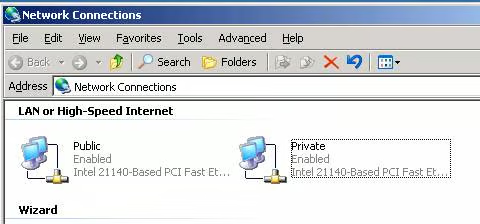
[Fig 1.3]
Verify the IP Address from the DNS [Fig 1.31] and update the
IP information of the Public network.
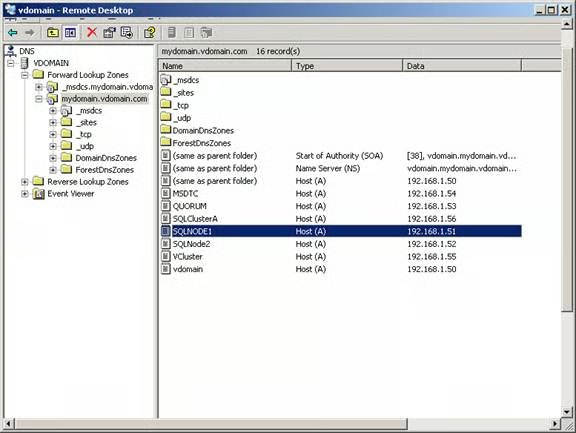
[Fig 1.31]
Update
the IP address of the private network as well.
Step 3 – Add the node "SQLNode1" to the domain.
Update
the machine name and add the machine to the domain. [Refer Fig 1.4 and 1.5]
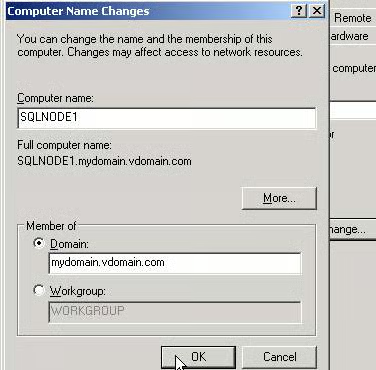
[Fig 1.4]
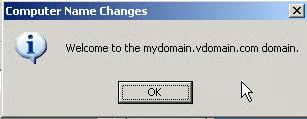
[Fig 1.5]