Sometimes an application may need data stored in another database on a different instance of SQL Server. That different instance might be on the same physical machine or might be on another machine altogether. So what do you do in this situation? Your options depend on your data requirements, like how up to date does the data need to be. Also, the network/computer topology might be a factor in what you can and cannot do. To discuss all the different possible options would make this article quite lengthy so let me narrow down the scope a little bit. For the purpose of this article, I will be discussing how a linked server can be used to seamlessly provide an application access to data on a different instance of SQL Server. Note linked servers can also be used to access other non-SQL Server data sources, but that notion will be outside the scope of this article. I will only be discussing options and situations related to using linked servers to access information stored in a SQL Server database.
Basic Linked Sever Architecture
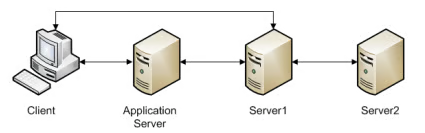
Before I get into how to setup a linked server, let me discuss the basic architecture of a linked server. A linked server is a mechanism that allows a query to be submitted on one server and then have all or part of the query redirected and processed on another SQL Server instance, and eventually have the results set sent back to the original server to be returned to the client. To better show how this works look at the following diagram:
In this diagram, a “Client” can connect to either an “Application Server” or directly to SQL Server to submit a query. If the “Client” or application running on the “Application Server” submits a query to “SERVER1” that needs to retrieve data from a database housed on “SERVER2”, then this kind of query is known as a distributed query. Defining a linked server definition for “SERVER2” on “SERVER1” allows for a client or an application to submit these kinds of distributed queries. A distributed query that runs against “SERVER2” from a linked server defined on “SERVER1” would look something like this:
SELECTname "DBs on SERVER2" FROM SERVER2.master.sys.databases
Here I identify the object I want to reference on my linked server by using a four part naming convention. In my example, I wanted to return the names of all the databases on “SERVER2”. Therefore, I used a four part naming which consisted of server>...
Gregory A. Larsen is a DBA at Washington State Department of Health (DOH). Greg is responsible for maintaining SQL Server and other database management software. Greg works with customers and developers to design and implement database changes, and solve database/application related problems. Greg builds homegrown solutions to simplify and streamline common database management tasks, such as capacity management.
Loading more content…
DatabaseJournal.com publishes relevant, up-to-date and pragmatic articles on the use of database hardware and management tools and serves as a forum for professional knowledge about proprietary, open source and cloud-based databases--foundational technology for all IT systems. We publish insightful articles about new products, best practices and trends; readers help each other out on various database questions and problems. Database management systems (DBMS) and database security processes are also key areas of focus at DatabaseJournal.com.
Advertiser Disclosure: Some of the products that appear on this site are from companies from which TechnologyAdvice receives compensation. This compensation may impact how and where products appear on this site including, for example, the order in which they appear. TechnologyAdvice does not include all companies or all types of products available in the marketplace.